Claudeshoring: Your Company's Best First AI Project is the One it Already Solved
Don't build your AI process from scratch. Lift one you already offshored.

Why enterprise AI projects are failing
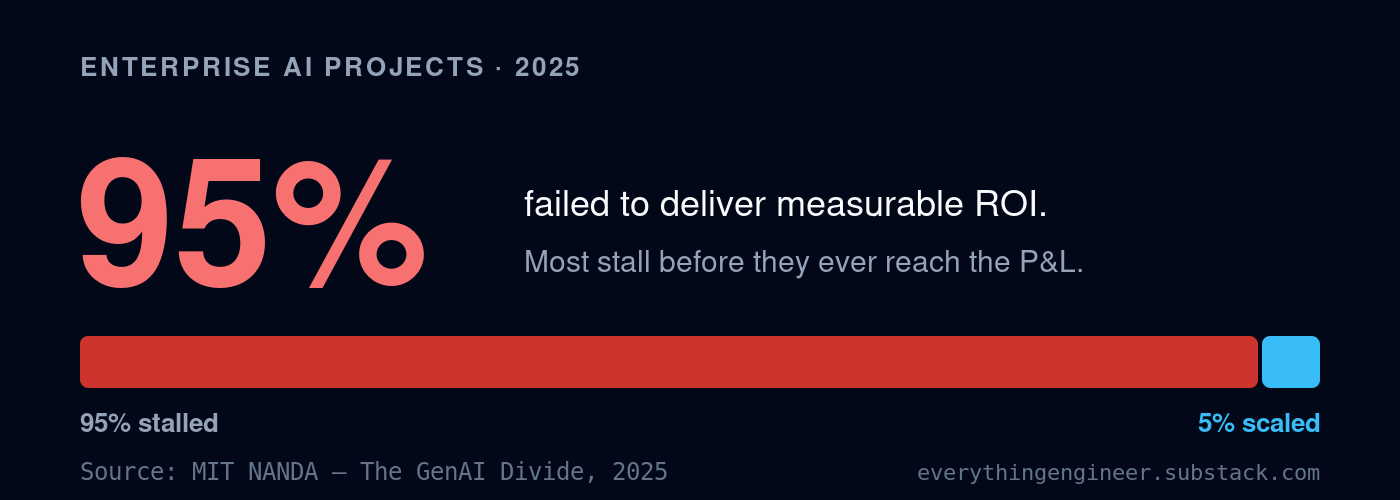
Last year, 95% of enterprise AI projects failed.
The MIT report behind that number — The GenAI Divide: State of AI in Business 2025 — has its own theories, but a big part of it is simple: enterprises keep picking the wrong project.
At Coolhand Labs we work with clients across the whole maturity spectrum, and picking the right first project is much harder for an enterprise than for a startup. A startup can take an immature process and grow the AI up alongside it — building it the way you’d build any human process: block by block from zero.
Enterprises don’t have that luxury. Standing up a never-done-before process as your first AI project is a recipe for failure. Even something as simple as an internal chatbot drowns in questions before it ships:
What tools should it be able to access?
How much access do we give it?
Which team has ownership of the project?
What metrics prove it’s working?
+ 100s of other critical questions with no obvious upfront answer
For this reason, we’d mostly written off pursuing enterprise clients when we launched. But something has shifted over the last few months. A handful of enterprise clients found a cheatsheet — one that answers all of those questions before they’re asked and takes them straight to the only stage that matters: we’ve got something running, here’s the ROI, do we double down or kill it?
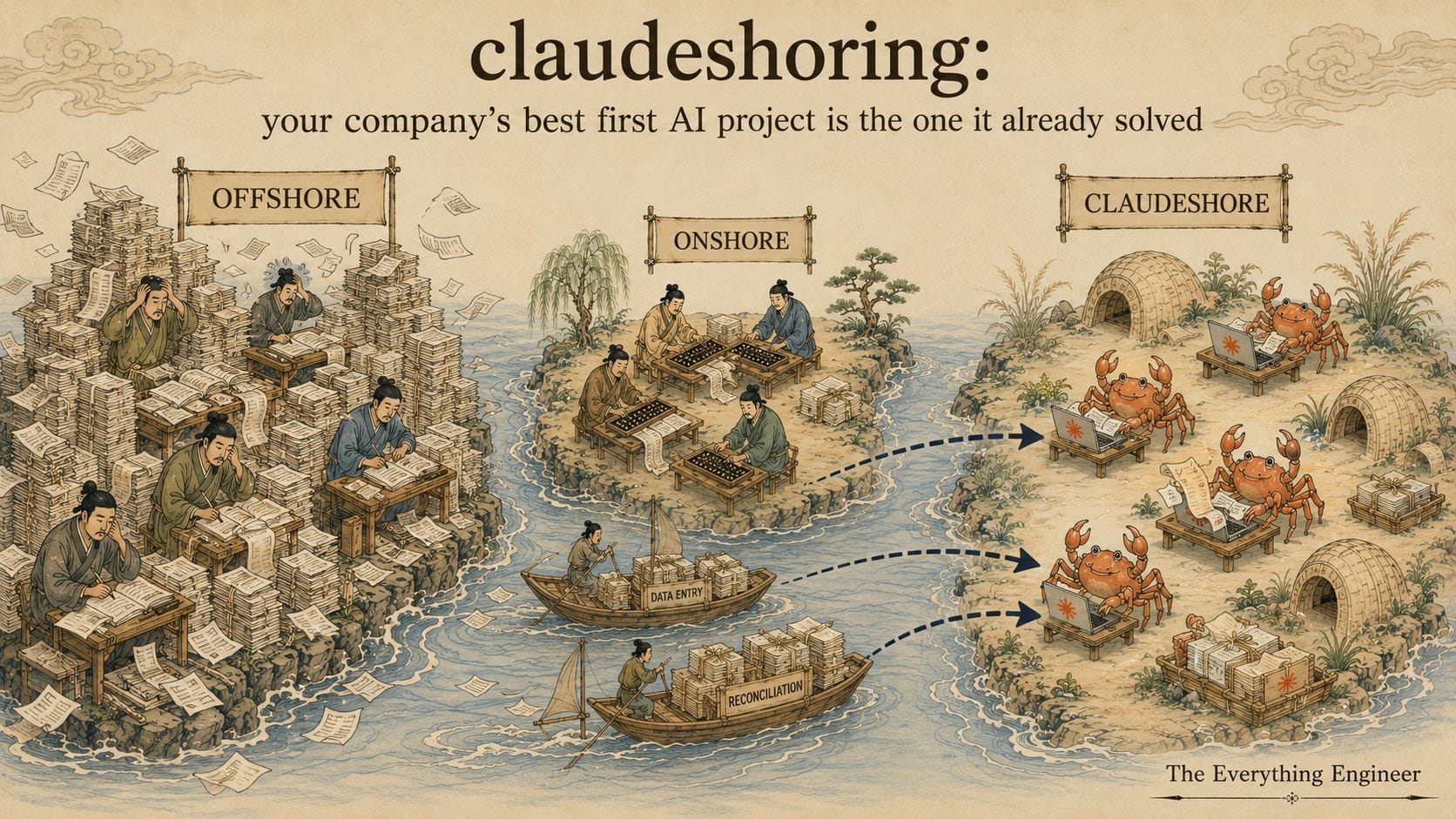
The secret? Something I’m calling claudeshoring.
What AI can’t do well
Before we get to what claudeshoring is and why it works, we need to talk about AI’s kryptonite: risk.
That deserves its own post, but here’s the short version. The core of any profitable business is taking on risk of failure in the hope of outsize reward. Do you spend on marketing or on production efficiency? Do you hire ahead of a forecasted surge in demand, or preserve capital and play it safe? There’s often no clear right answer.
AI can go through the motions of these decisions, but — as things stand — it can’t validate the decision on the fly in its session and never has to live with the consequences of failure. AI agents don’t have mortgages to pay, reputations to protect, or swimming pools they want to buy with that Christmas bonus. Agents’ appetite for risk extends only as far as their context windows.
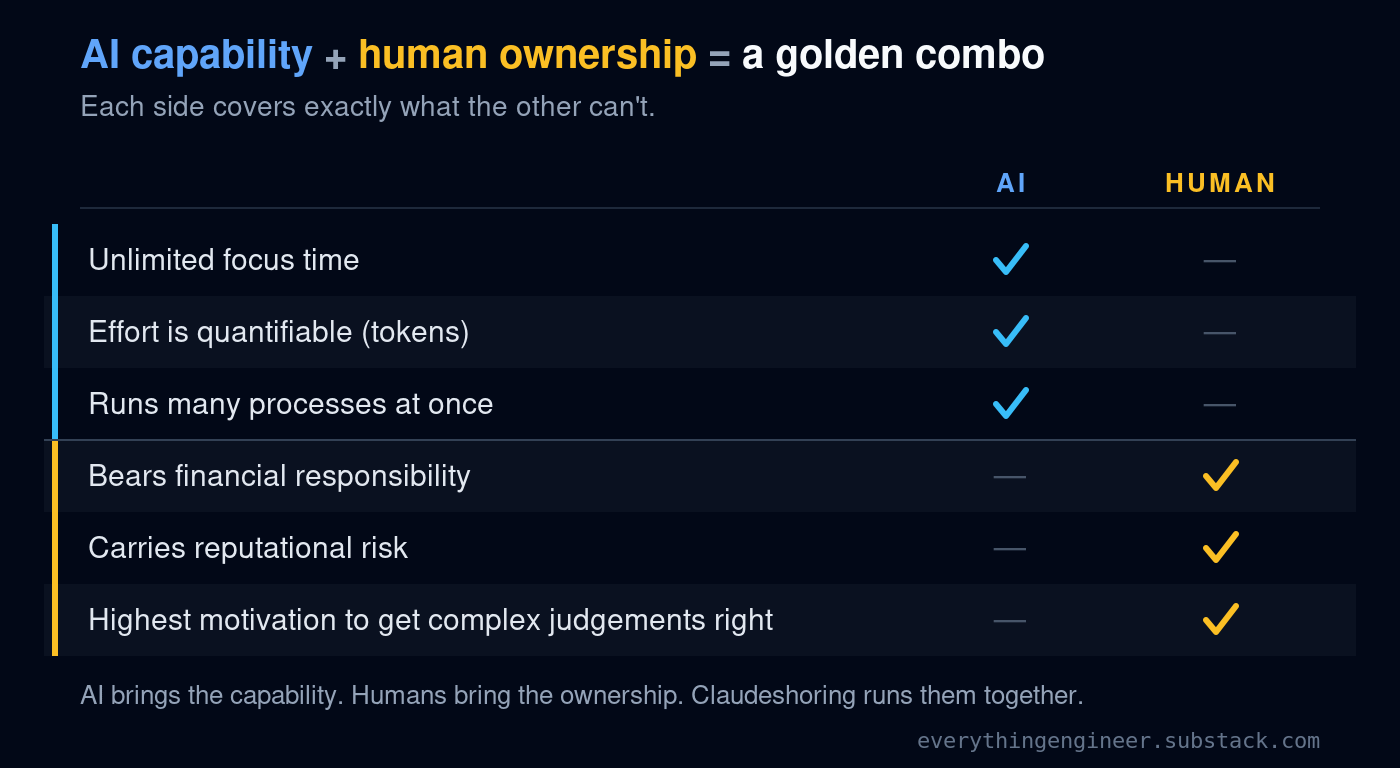
Which means everything downstream of risk — owning an outcome, making judgment calls around ill-defined variables — is the stuff AI is worst at. It’ll make a convincing argument for what to do, sure. But it never has to face the partner across the kitchen table when the bonus evaporates — and the pool deposit goes with it.
So your best AI candidate is a process you’ve already stripped of both: the need for an owner, and the need for long-horizon judgments. Something you can hand off as a written process document, with failover built in — automated rubrics, managerial review — to double-check the work close to real time.
The best process to move to AI, in other words, is one you’ve already offshored.
That’s not just my read. That same MIT report found the biggest AI returns weren’t in the sales-and-marketing tools soaking up most of the budget — they were in back-office automation: cutting agency spend, streamlining operations, eliminating business process outsourcing. The highest-ROI place to point AI to the work you can claudeshore.
Offshore to Claudeshore: All you need is a map
If your company has offshored a process, it probably went through a checklist like this:
✅ define the process and the result(s) you want
✅ break it into steps and subprocesses
✅ build a way to measure the quality of the output at every point you can
✅ specify every tool (and level of access) the process touches
✅ write the whole thing up in a handbook
✅ put someone in charge… and properly incentivize them to keep the process aligned with company goals
Now ask what an AI process needs. Basically the same things, just named with new AI jargon:
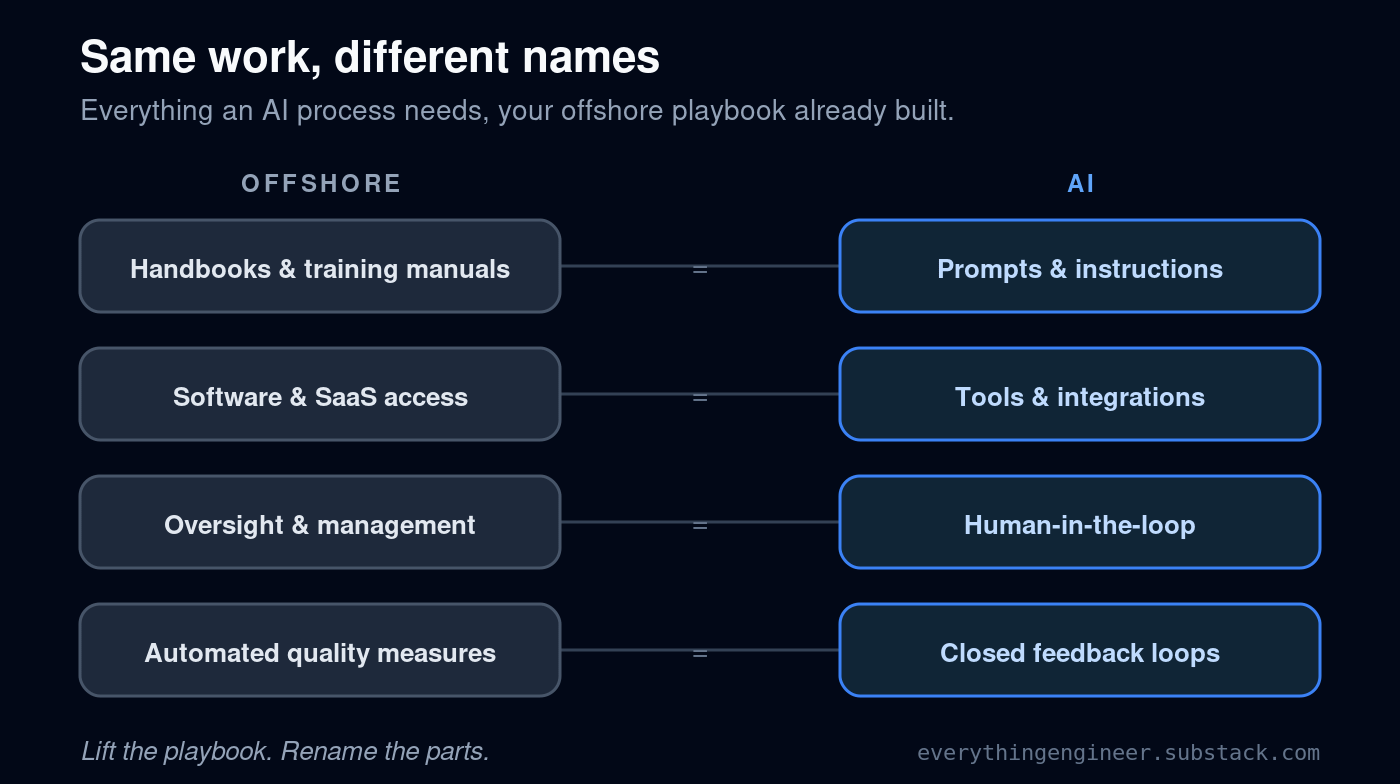
If your offshore setup is genuinely buttoned-down, you can move the process to AI as a near-literal lift-and-shift:
take the machine image or virtual desktop you spin up for new offshore hires
run it on a server
provision the AI its own accounts, with the right access
load the training and reference materials onto the desktop in a searchable format
point a full system-control tool (OpenClaw, Hermes, Claude Code, the like) running a capable model at the machine
give it some basic prompt instructions with what success looks like and where its reference guides & access creds are
Bam! An MVP of your AI process, with maybe a few days of wiring that you had Claude Code do for you.
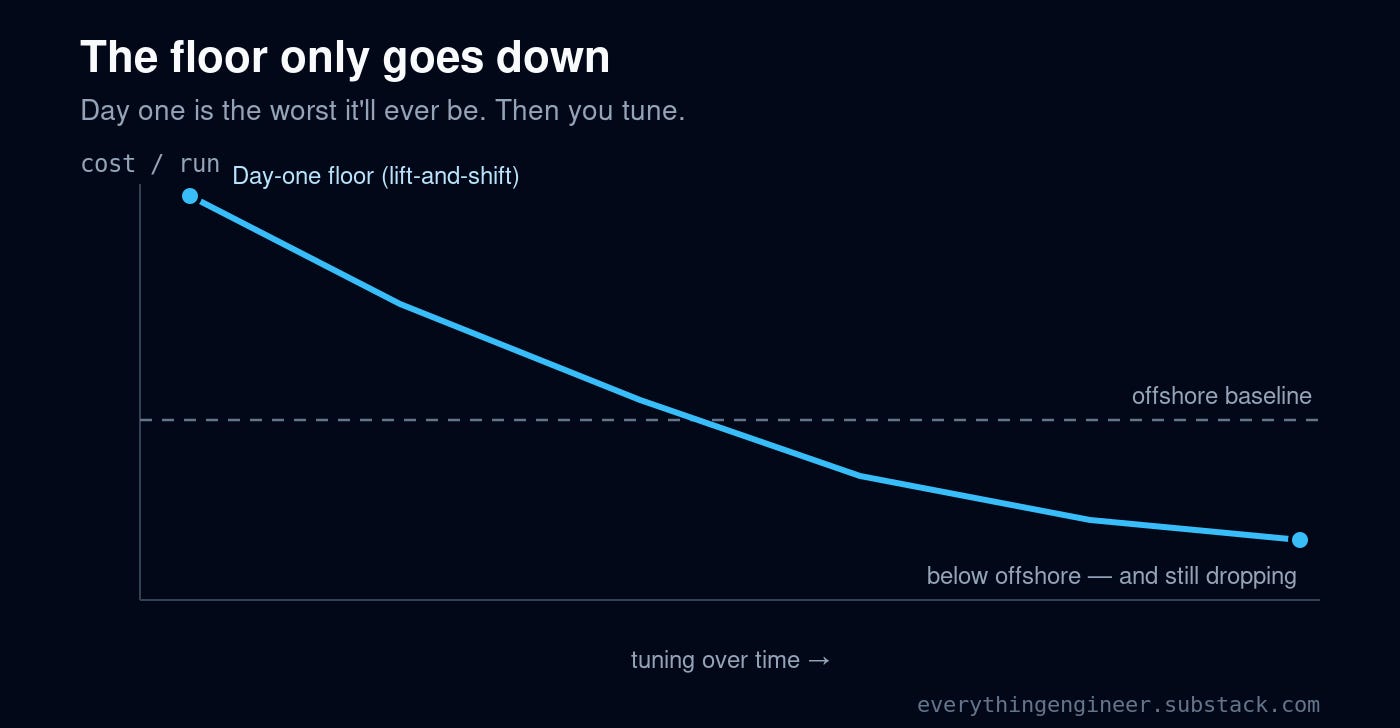
Of course, this lift-and-shift won’t be cheap or polished. It’ll need significant prompt tuning, and having an AI use your existing SaaS GUIs instead of calling tools directly is wildly token-inefficient. But now you’ve pinned down two key numbers: the worst-case cost of running this process on AI, and the worst-case quality you will get from the results. That’s your floor.
And a floor is a powerful number to have! Everything from here only gets better. And now the question changes from “will it work?” to “how much better can it get?”
So… how much better can it get?
I’m not going to pump the hype too much here: the first time you claudeshore a process, you may not save much. You might even go backwards — slower, pricier, worse quality. GUIs are token-hungry, prompts need tuning, and humans still pick up a lot of knowledge and judgment in the training process that won’t sit in any document.
So why do it? Two big reasons:
1. Elasticity is a superpower
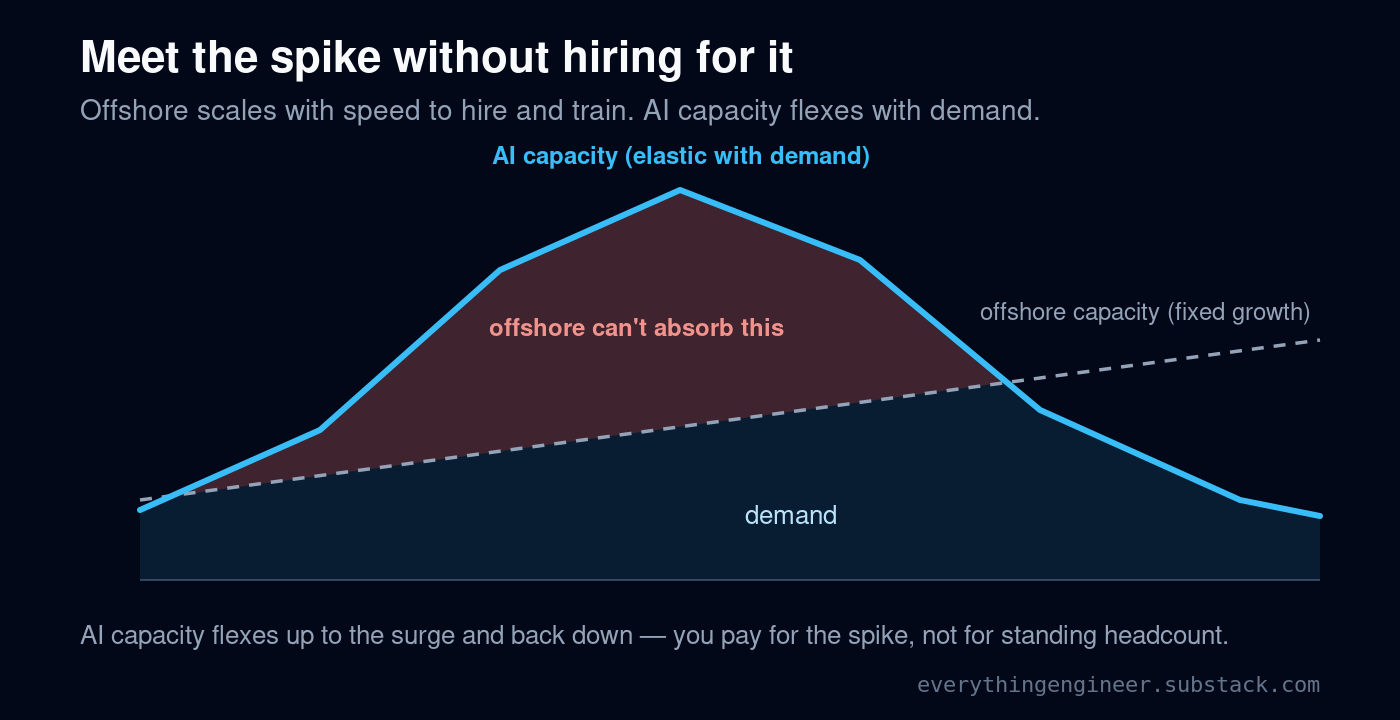
Right away with claudeshoring, you get one thing that’s always been elusive with labor processes -- elasticity.1 Need to crunch through a 10x crush of claims that need to be classified and responded to? AI tokens are not an infinite commodity right now, but there are surely enough out there to manage your spike... and then some. So, from elasticity alone, you are gaining a huge business advantage in terms of speed and flexibility you never had before.
2. Numbers don’t lie
Second, and more importantly, claudeshoring a process allows you to walk away with a quantified understanding of the process that you simply never had before.
Every step is now instrumented. You can see exactly what each step received (the input data & instructions), what it produced (the output), whether the output was right (human feedback), and what it cost — down to the token. For the first time the economics of that process are measured, not estimated, at a precision no human-run process can provide. You’re not guessing where the waste is. You’re getting a down-to-the-penny accounting of it from a dashboard.
And because the whole process is now just instructions and criteria, you change it the way you change software. Test a tweak against real cases, confirm it’s better, and roll it out everywhere — overnight. No retraining a cohort, no waiting months for a new SOP to propagate. The managers who own these processes don’t get replaced by the AI; they get amplified by it. Your single best operator can now improve the work of a hundred AI “workers” by the end of the week.
That’s the part that compounds. The labor savings get the meeting. The instrumentation — and the speed of improvement it unlocks — is what builds it into a business moat.
More on this to come.
There’s one catch, and it’s worth a post of its own: these processes drift. Keeping your AI aligned as the business moves is a discipline in its own right — and it’s where claudeshoring either compounds or quietly rots. But that’s for another post.
But, those caveats aside, if you have offshore processes, the very best way to start building AI capabilities and competence in your organization is to claudeshore those processes.
Claudeshoring starts from finished, and just keeps improving faster from there. The highest-ROI AI project you can run was never the most ambitious thing on your roadmap; it’s the already-solved process you paid to perfect years ago.
So stop hunting for the right AI project. Claudeshore the one you already solved.
Michael Carroll is the founder of Coolhand Labs, a COO for your AI processes — keeping an eye on your running agents so your offshore-to-AI operation doesn’t become the plot of Cast Away. He has now told five people at parties what “claudeshoring” means and is cautiously optimistic the term will outlive the pun.
Devotees will notice that my last post was ALSO about elasticity -- it’s a big benefit of AI that is underappreciated right now.