Why Engineering Managers Are the Most Valuable Hires in AI
While engineers, PMs, and designers argue over who AI makes redundant, former managers are shipping more product than ever without them.

Marc Andreessen has a name for what’s happening right now between engineers, product managers, and designers. He calls it the Mexican standoff:
Every coder now believes they can also be a product manager and a designer, because they have AI. Every product manager thinks they can be a coder and a designer. And every designer knows they can be a product manager and a coder.
If you’ve spent any real time in technology leadership, this standoff should be familiar from long before AI. It’s been playing out in product reviews and sprint planning meetings for as long as there’s been software. Each of these three groups secretly believes that, if they cared enough, they could do the job of the other two. But, they tell themselves, they don’t care enough, so they need the other two for now. It’s the engineering world’s Mutually Assured Destruction work dynamic.
But in the era of AI, the knowledge and capability gaps between what each can do have shrunk considerably. You don’t even need to care that much to vibe code a feature, build a UX interface that looks pretty slick, or do... whatever it is that product managers do 😉.
So who is actually winning in this new dynamic? Turns out: none of them. It’s the engineering manager.
Anthropic Is Paying a Premium for People Leaders with No People to Lead
Let’s talk about two categories of viral posts that have been buzzing around social media.
The first: Someone finds an Anthropic job listing — $570K total comp for a software engineer, with a note at the bottom that the role “may not exist in 12 months” — and pairs it with Dario Amodei’s repeated statements that AI will handle most or all of what engineers do within six to twelve months.
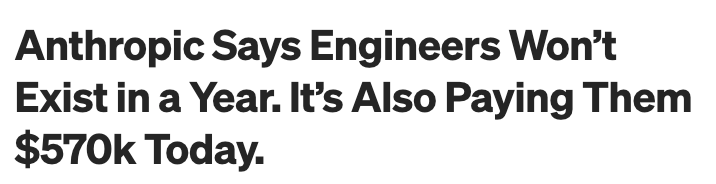
The reaction online? Hypocrites.
The reassurance in the comments? Engineers still matter, don’t panic.
The second is a more recent phenomenon. A CTO left a public or high-growth start-up to be a technical contributor at Anthropic. Peter Bailis, for example, who left as CTO of Workday — an $8B revenue, 18,000-person company — to join Anthropic as a “Member of Technical Staff” focused on reinforcement learning. Mike Krieger, co-founder and CTO of Instagram, joined Anthropic as CPO in 2024 and then stepped back in January 2026 to be a technical staff member. Other high-profile announcements keep following.


The reaction? Wow, Anthropic must be the hot place to be. A talent signal. A prestige move.
Sure. But both readings miss the bigger point: Anthropic thinks that the winners in the new future are engineering-minded people managers. Technical leaders who, at some point, moved from building things to building and managing the systems and teams that build things — and kept their core skills sharp while doing it. People who’ve spent years owning complex systems, managing dependencies, reducing risk, and delivering despite chaos.
And a growing number of managers are showing they are very happy to give up managing people and become super-powered individual contributors.
Why Managers Can Do It All
Back to the standoff.
Others have noted that Andreessen’s word choice implies the designer has the edge — the coder believes they can do it, the PM thinks they can, the designer knows it. Maybe. But the more important thing his framing reveals is that all three are optimizing for the same thing: proving that their slice is the most valuable one.
That’s the IC trap, and it applies equally to coders, designers, and PMs. The engineer owns the code. The designer owns the interface. The PM owns the requirements. When something ships and succeeds, they can each claim credit for their domain. When it ships and fails, they can each point at the seams between them.
The engineering leader has no seams to point at.
This is the structural reality that most commentary on AI and engineering roles has missed: the engineering manager is the only person in the standoff who has been required - not encouraged, not advised, but structurally required - to hold the whole system. Not because they’re smarter or more experienced, but because their accountability doesn’t stop at a domain boundary. They own the outcome. When it fails, it’s on them. When the postmortem happens, they’re in the room. That constraint -- the real consequence of failure landing on you specifically -- is what forces a particular kind of thinking.
That thinking is: how do I get code, design, product judgment, and delivery to come together good enough to ship something that works? Not best-in-class on any single dimension. Coherent across all of them, in the right sequence, under real constraints, with real skin in the game.
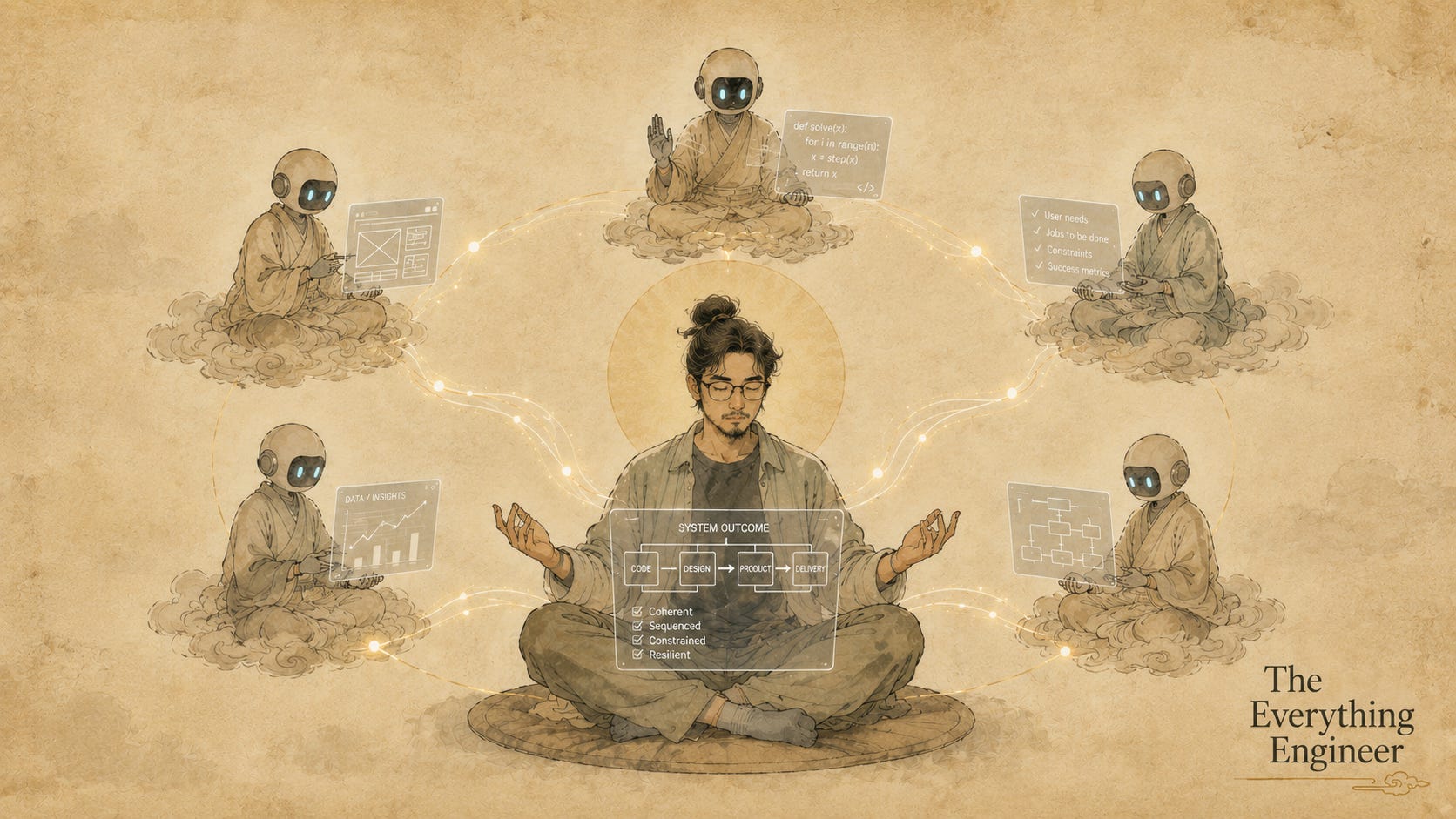
That is exactly what building with AI requires. You are not writing the best code or producing the cleanest design. You are orchestrating a system of pieces and making sure the whole thing holds together and gets somewhere. The engineering manager isn’t learning a new discipline here — they’re designing a system that maximizes outcomes while trying to be as resilient to failure as possible: they just went from doing that with teams of people to doing it with teams of AI agents.
The IC standoff is ultimately a debate about whose slice matters most. The engineering manager stopped having that debate a long time ago. They’re the one who had to talk the gunslingers down, figure out how to move forward if they couldn’t, and own what happened either way.
That responsibility and ownership is what gives them the range to do it all — and it’s the one thing AI can’t manufacture from scratch.
The Next Big AI Crunch is Not GPUs
A few months back, I had a discussion with some former colleagues about how to hire in the age of AI (and AI-assisted interview cheating). Eventually, we all came to the same conclusion: a lot is up in the air, but the one thing that always defined the best hires pre-AI is still the best signal for great hires post-AI... a true passion for building things.
This is also a truism of great managers. The best managers I’ve promoted in my career were not the most technically competent, or the best “people persons”, or even the smartest thinkers. They were builders. They saw management as a way to either (a) build more at scale or (b) help others build or, often, (c) both. The pitch I always made in trying to coax somebody that I thought would be good at the role into management was the same: yes, there’s a lot about the role that’s a grind... but just imagine the scale of what you can build now.
That “trade” got progressively worse over the years. The pandemic years brought enormous growth pressure and relentless churn — managers spent months hiring and ramping someone up, then watched them walk for $30K more. Then the correction hit and layoffs followed: who had to decide who was on the list, justify it upward, deliver the news to those affected, take all the flack, and STILL own delivering on everything? Yup, the managers.
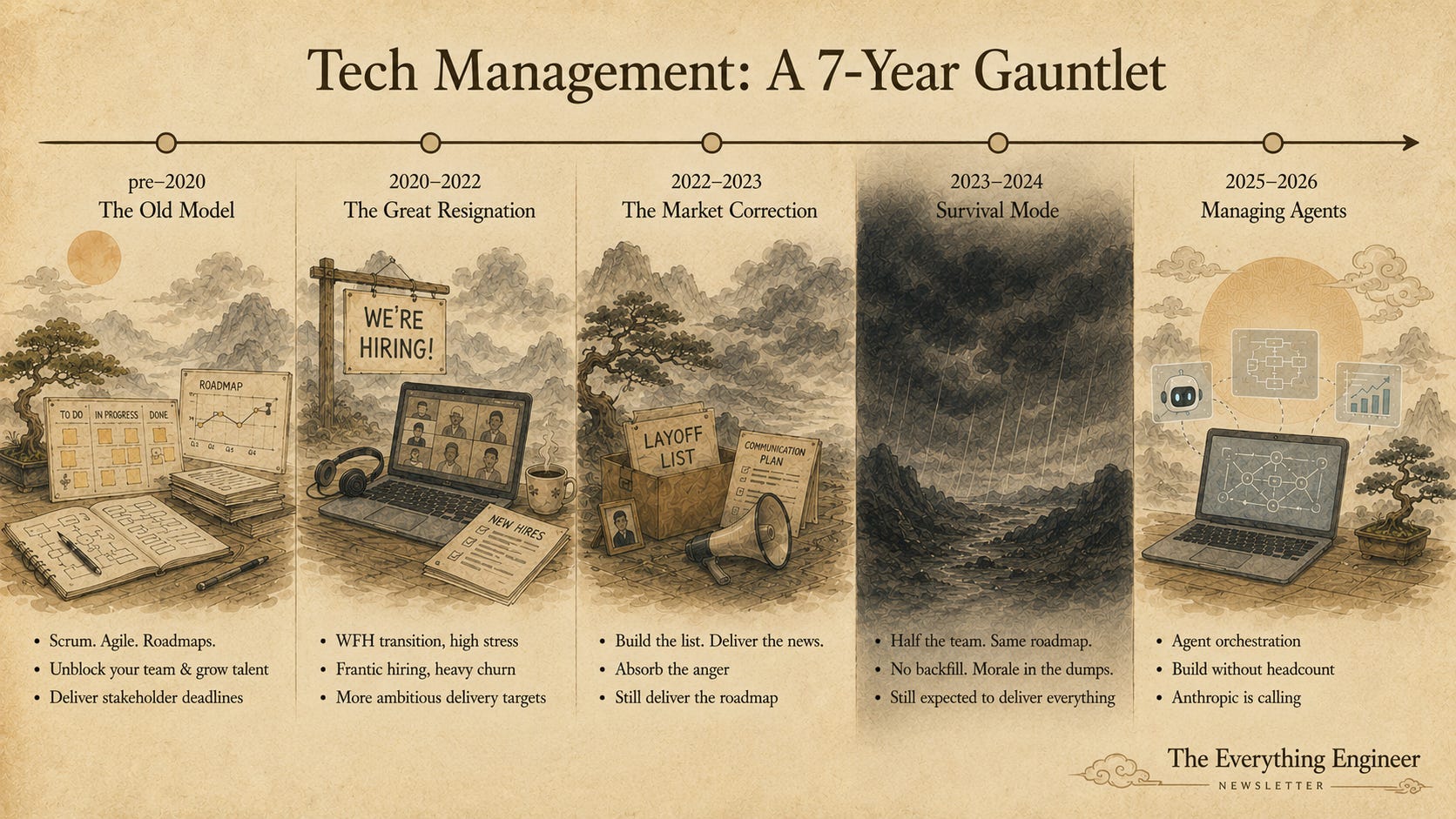
The result is a cohort of technical leaders who are battle-tested in ways that are genuinely rare — people who’ve made hard calls under time pressure, delivered under impossible constraints, and built systems that function when the humans inside them are unpredictable.
And a lot of them are looking at AI agent orchestration and thinking: I can build at scale again. I can get paid well. And I don’t have to manage churn, run layoffs, or catch all the blame for decisions I didn’t make.
Imagine being the sheriff of rough-and-tumble Dodge City and being offered a higher-paying job as a civil servant in a town where everybody just works together and there’s not a gun to be seen. Who wouldn’t leave in a heartbeat?
Dear CEOs: Your “AI Strategy” Starts With Your Managers
If you run an enterprise company or a scaling startup, this is the part you need to pay attention to.
Your most important retention target right now is not your senior individual contributors. It’s not your domain experts. It’s your highly technical, hands-on engineering leaders — the ones who stayed technically sharp even as their IC time shrank, who’ve owned risk and delivery outcomes, who know how to build complex systems under real constraints.
These people were probably always valuable to you -- the steel that held up your org structure. Well, now steel is in rare supply. If you aren’t careful, it’s going to be stripped from your building, leaving not much to hold things up.
The real opportunity is to put these people at the center of your AI transformation — not as sponsors on slide decks, but as the hands-on architects of how your organization operates. The way you build. The tools you build with. The systems you use to reduce risk and increase delivery confidence. These are exactly the problems they’ve spent their careers solving. Give them the mandate & ability to choose the tools they need to solve them.
The risk of not doing this is specific and urgent. Anthropic is building dream teams of your tech leaders. AI-native startups are picking up whatever the frontier labs don’t claim. Some people in your company can (and will) certainly rise to fill the vacuum when your leaders leave, but you will already be on your back foot when they do.
The urgency of this moment is not about adopting AI or using AI to cut down on unnecessary roles, it’s about identifying and doubling down on the right people and giving them the latitude to build the next version of your company... because when they are gone, the only way they are coming back is when the board replaces you with them.
Dear Everybody Else: You’ll Manage
And if you aren’t an enterprise CEO or an in-demand technical leader? The takeaway I’d have here is that AI isn’t killing jobs, but changing them. Learning how to build fault-tolerant systems that scale -- whether systems of agents or of software or both -- is something everybody can learn... and learning it can be easier if you approach it right.
But tips & tricks on getting there are things I will cover in future posts. For the moment can I just recommend that you holster your weapon?
Michael Carroll is the founder of Coolhand Labs, which provides an AI COO that improves your agent teams. Having hung up his management badge and gun three years ago, he tells everybody his sheriff days are long behind him... but still keeps a watchful eye on the horizon anyway.
Great article!